Early Means of Mass Production
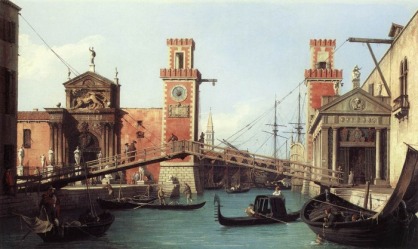 The Venetian Arsenal was far ahead of its time
"As one enters the gate, there is a great street on either hand with the sea in the middle, and on one side are windows opening out of the houses of the Arsenal, and the same on the other side. Many vessels were in the process of being constructed. Everything seemed to have a certain flow and grace to it."
~A Spanish visitor talking about the Arsenal in 1436 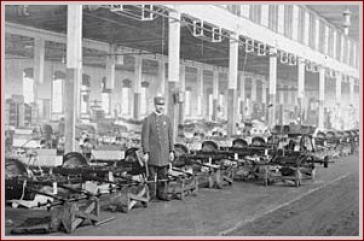 Ransom E. Olds and his assembly line
“The most important people of the time for the development of the assembly line were the Americans Oliver Evans and Eli Whitney and the Frenchman Gaspard Monge.”
~answers.com |
Henry Ford did not invent mass production; he simply perfected it. There were primitive forms of production dating all the way back to ancient Egypt. The Venetian Arsenal was one of the first systems to utilize this idea. Many ideas from multiple people led up to the implementation of the moving assembly line. Ransom E. Olds alone was one of the biggest contributors as he was the first to patent the stationary assembly line.
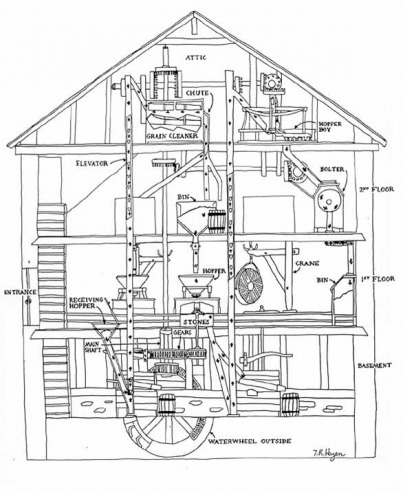 Although it could not be accurately described as an assembly line, Oliver Evan's flour mill was a precursor to the moving assembly line
“Americans like Eli Whitney and Oliver Evans had pioneered ways to manufacture things more quickly, precisely, and cheaply many years earlier, and Ford put their ideas to brilliant use.”
~David Weitzman |
